
OpenStack Backup and Recovery, Agentless and Native, Cross Mutli-sites Ready with One Click
Uniview Vault: OpenStack‑native backup, seamless multi‑site mobility, and instant disaster recovery built simple
An OpenStack native solution for backup, disaster recovery, workload mobility, and serving tools for devops daily operations. Uniview Vault turns traditionally complex, siloed backup process into one click by thin and orchestrated wrapper and leveraging OpenStack and Ceph primitives you already run. It comes along with Uniview Core with no extra cost and maintenance.
One-click Workload-In-Motion
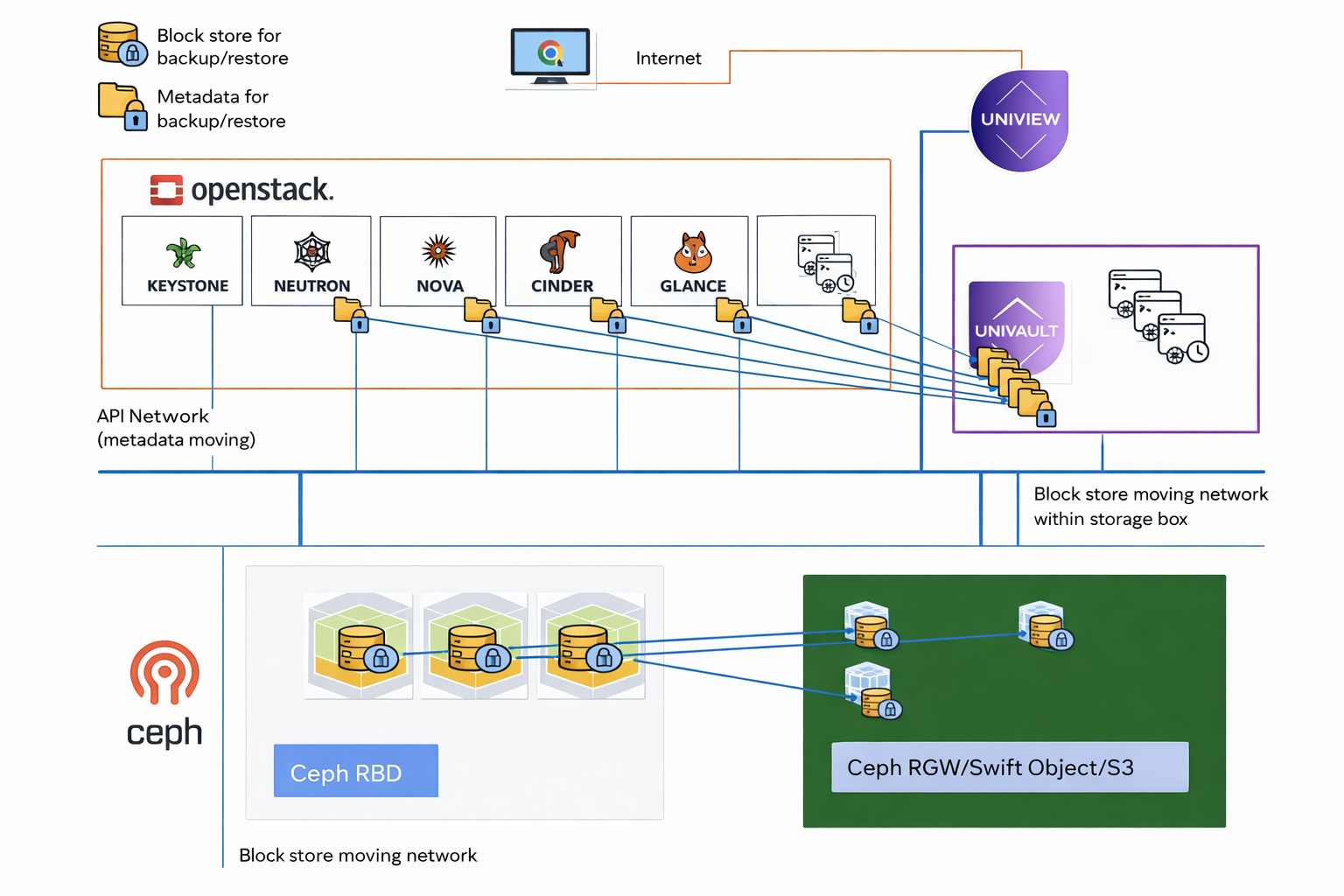
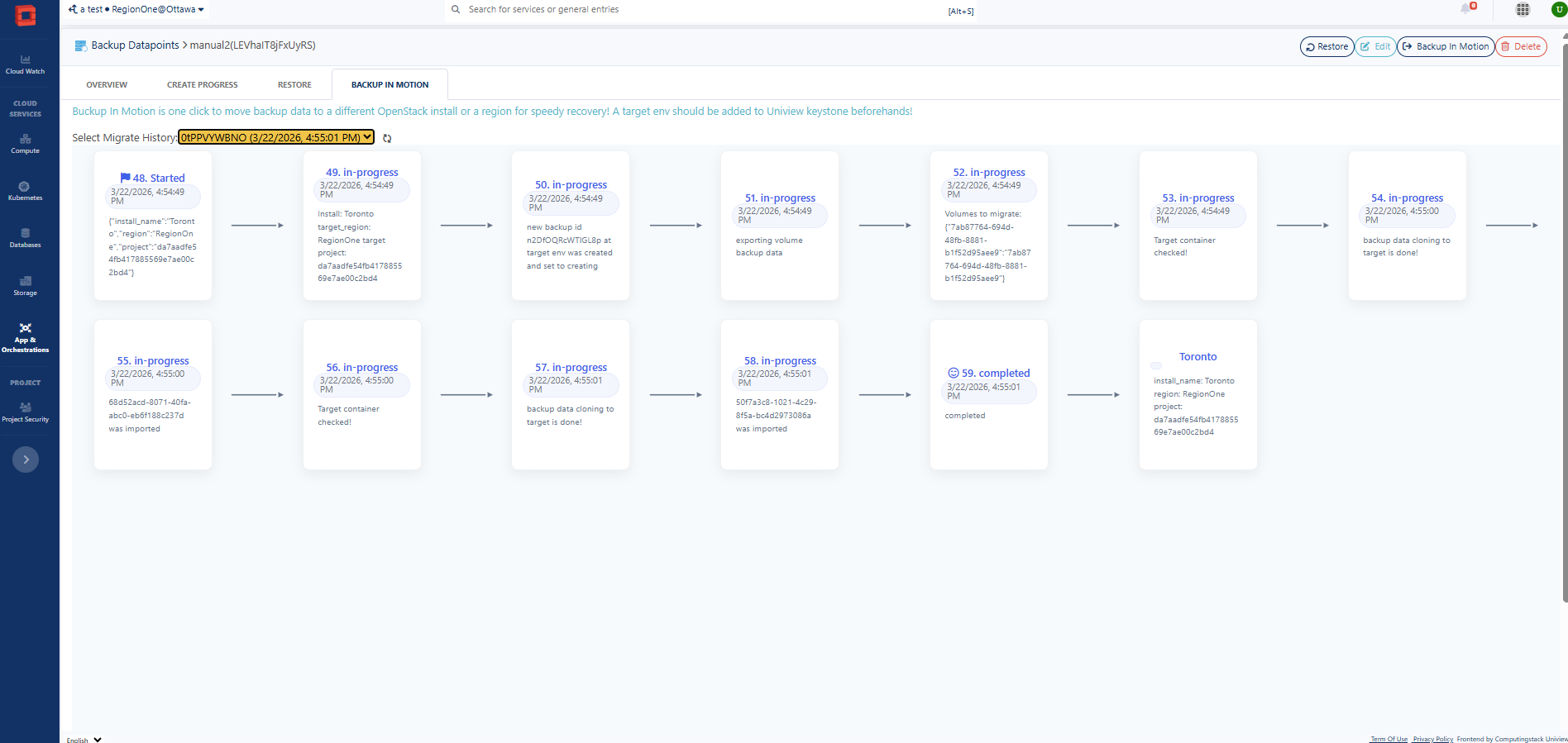
Pioneered Backup-In-Motion solution in the industry, it performs one‑click backup and recovery of VMs from one OpenStack environment to another without requiring any shared components between them. This is made possible through the powerful Uniview User Console of OpenStack and its clustering capabilities, which automate the entire process. Backup, Put in Motion, and Recover are all by one click as simple that there is no room for mistaking. With Uniview, there is no need of snapshotting, download, copying, re-composing info of instance creation any more, the process is as concise and quick as Live Migration between hypervisors and within same cloud. Backup-In-Motion makes mutli-OpenStack truly meaningful to business as one failover solution at disaster when data sync can be well faciliated by Uniview Vault. From taking backup at env A, puting in motion to have it replicated to B, to recovering by one click, it can be as short as minutes, and all process is within same console without hoping off/on by a few clicks.
Achieving Best OpenStack Workload Resiliency At Low Cost
Leveraging the potentials of existing systems such as ceph rbd copy, rbd diff, nova quiescing, cinder backup, neutron api and swift/rgw cluster etc,
Uniview Vault barely requires complexity neither local storage or network for data transit, hence it is more reliable and efficient.
Uniview provides resilient offsite backup and DR by easily spreading data across external storage or shared‑nothing remote OpenStack, safeguarded by three or more geographically distributed recoverable replicas. Incremental backup will be taken at configurable pace by users to have best RPO.
Its performance is ensured by the way of data handling too, when there is no need of delta computing that data movers often do. Uniview doesn't need data mover.
Instead Uniview delta computing leverages Ceph RBD metadata only without touching real data. Different from data mover or proxy when it does download and upload locally, Uniview Vault does only server side copying without local download/upload.
Not a Luxury Any More, Back up and DRS Now Is A Commodity
With Uniview, cloud administrators are freed from being tied with tenant workload and their daily backup. Tenants use their own multi-tenancy storage, manage their own migrations to cross clusters, track the status of their own jobs, and troubleshoot their own issues.
All are facilitated.
Instead of centralized storage traditional backup solutions often uses, Uniview is more focused on multiple-tenancy storage, though, CSP still has option of centralized storage by GCS/NFS/S3 etc.
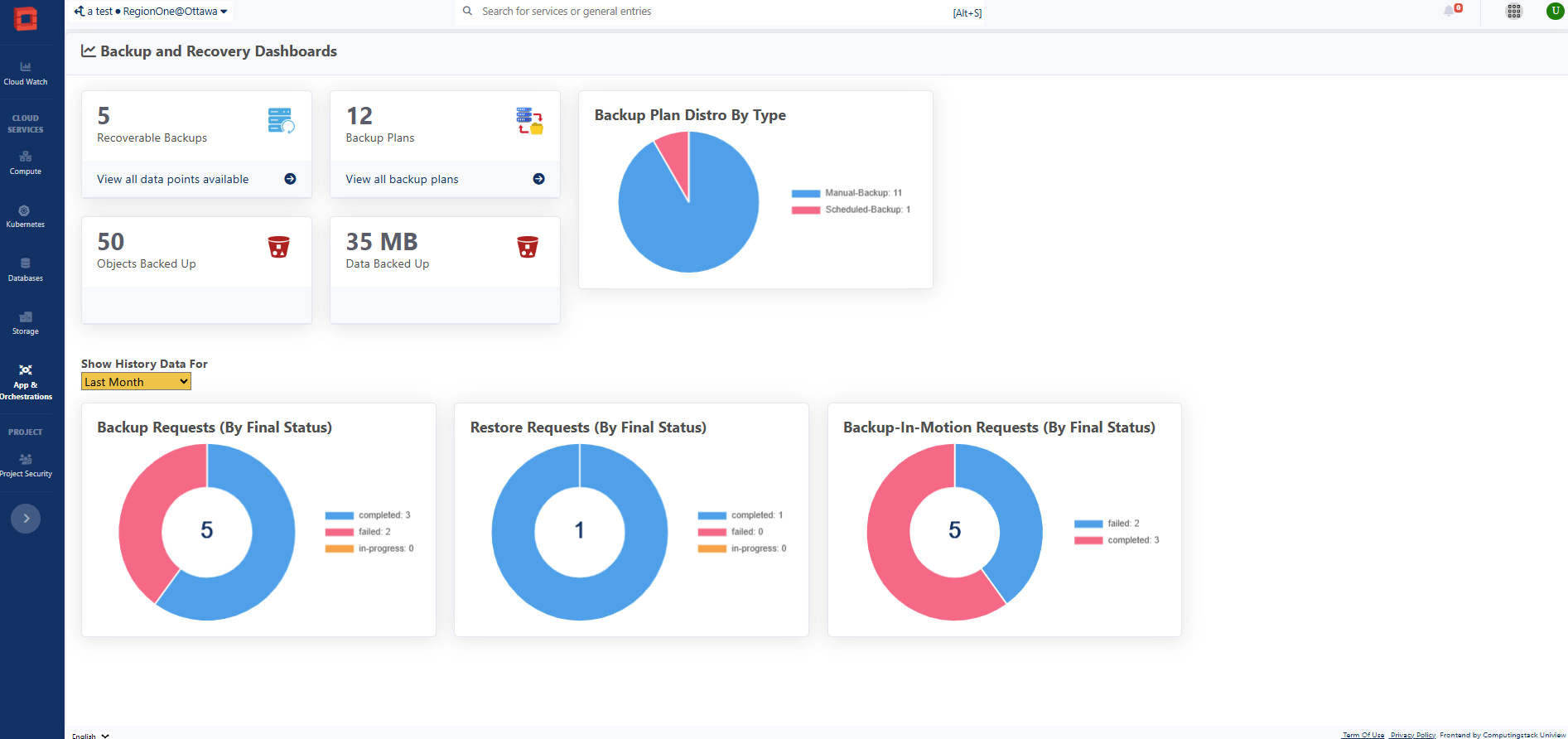
From creating and scheduling backups to restoring, all is one click away. Uniview Vault is fully integrated with the Uniview user console without need to hop back and forth between different places and systems.
Uniview backup is so accessible and in such natural way as simple as creating a VM, and yes, it's a commodity not complicated nor expensive any more.
Manageable, transparent, operable, and affordable — a perfect balance of open source and thin proprietary engineering
Uniview Vault leverages open source APIs and services to turn a highly complex and often expensive process into a well‑accessible, reliable workload protection solution native to OpenStack. Uniview Vault also orchestrates various services to accomplish workload recovery with traceable logs and events. Uniview Vault easy install and daily administrating over intuitive UI is natural as requiring nearly no extra efforts, which is a signficant difference from other solutions when dedicated administrator and complex process are required due to the complex topology.
Highest Standard of Source Application Consistency While Agentless to Ensures Best Recoverability
Uniview Vault implements a high standard of application consistency by coordinated quiescing and application freezing in a graceful way, so that data backed up from volumes or snapshots has the best recoverability. All processes are achieved through orchestrated API calls without agents. Supported storage media include AWS S3, Swift, NFS, GCS (Google Cloud Storage), Ceph, and other common storage systems. Full and incremental backups are available within a few clicks.
Easiest Integration Without Dependency on Controller/Hypervisor neither Proxy Integration
Unlike solutions from legacy that often install movers or api extentions, or proxes into the controller and hypervisor, they work but also significantly increased solution cost and maintenance overhead. Those deep dependencies can be intrusive that cause sustainability issues. Uniview Vault fully leverages Uniview core and the OpenStack API only to accomplish the same tasks efficiently. Nothing is required on Nova/Cinder controller, nova‑compute/Ceph; no proxy or agents are needed, while it still achieves the desirable filesystem‑consistent backups required to meet industry standards in the OpenStack world. Barely cloud administors need attentions on Uniview vault in their upgrading and daily operations.
One‑Click Backup In Motion
Short demo: one‑click backup, workload mobility, and one‑click recovery.
Uniview Vault orchestrates OpenStack and Ceph primitives to perform live backups, move workloads between clusters, and restore with application consistency.
- One‑Click Workload‑In‑MotionMove VMs across OpenStack clouds without data movers.
- Application‑consistent BackupsQuiesce and freeze without agents where possible.
- Offsite & Cross‑CloudServer‑side copy to RGW/S3 or remote Ceph.
Find the answers for the most frequently asked questions in Sales and Get-started
What Data Consistency by Uniview Vault Backup Data?
Under the hood, Uniview leverages Nova Quiesce, Cinder Snapshot, Cinder Backup, Ceph RBD, full APIs all together to achieve data consistency to be file system consistent. With generic qemu-guest-agent or user self extension when needed, Uniview can accomplish desirable application consistency.
Does Uniview Vault Require qemu-guest-agent too?
YES. Uniview Vault is agentless, and instead it relies on qemu-guest-agent too to freeze the file system for getting consistent backup data. The image should have properties setting of such, as most solutions require, and VM is highly recommended to have it at boot, such as by user data. User can choose easy enablement at instantiation or edit instance to signal its capacity to Nova and Uniview Vault, if quiescing is applicable to user workload at backing up.
What RPO and RTO Is Anticipated with Uniview Vault?
With support of Uniview scheduler and incremental backup, RPO can be as minimal as minutes technically. Taking backup has impacts on performance of application in short manner, in real world, the incremental backup frequency practice can be optimized to have a balance.. With well orchestrated services by Uniview Vault, RTO can be a few minutes to restore an env. Literally one click with a few seconds RTO is possible to automatically rollback and restore workload running env to the state it was.
Is Uniview Vault Compatible with My OpenStack Install?
Yes! Different from solutions that often install data mover or API into compute and controller node, which needs to work with binary, socks or container installed by installers such as Canonical Juju and Redhat OpenStack, Uniview uses only API, and there is no constraint to work with known distros, regardless how it was installed.
Is Uniview Vault Scalable?
Uniview Vault works with multi-tenant storage such as Swift Cluster, and there is unlimited scalablity by underlying Swift Cluster or Ceph RGW. All data copying incurred by Uniview is high efficient server side copy, CEPH rbd copy, Ceph network copy and there is no local traffic generated. There is no network bottleneck along the path.
See Uniview Vault on your OpenStack.
Walk through Backup‑In‑Motion, incremental backups, and one‑click recovery on a real OpenStack environment. Explore how Uniview Vault fits into your existing Ceph and OpenStack topology.
Talk to us
Share a bit about your OpenStack deployment, storage backends, and DR objectives. We’ll map Uniview Vault to your environment and outline a practical rollout path.