Multi‑Tenant K8s Platform That Delivers Cloud Experiences — Ready Tenant Isolation, Fleet management, PoD/Serverless Console, Cost Tracking and More
K8s Multi-Tenancy, Fleet Management and Application Platform with Built-in Billing ( Beta )
A lightweight platform that makes sharing Kubernetes within an enterprise or selling it to external clients instantly ready.
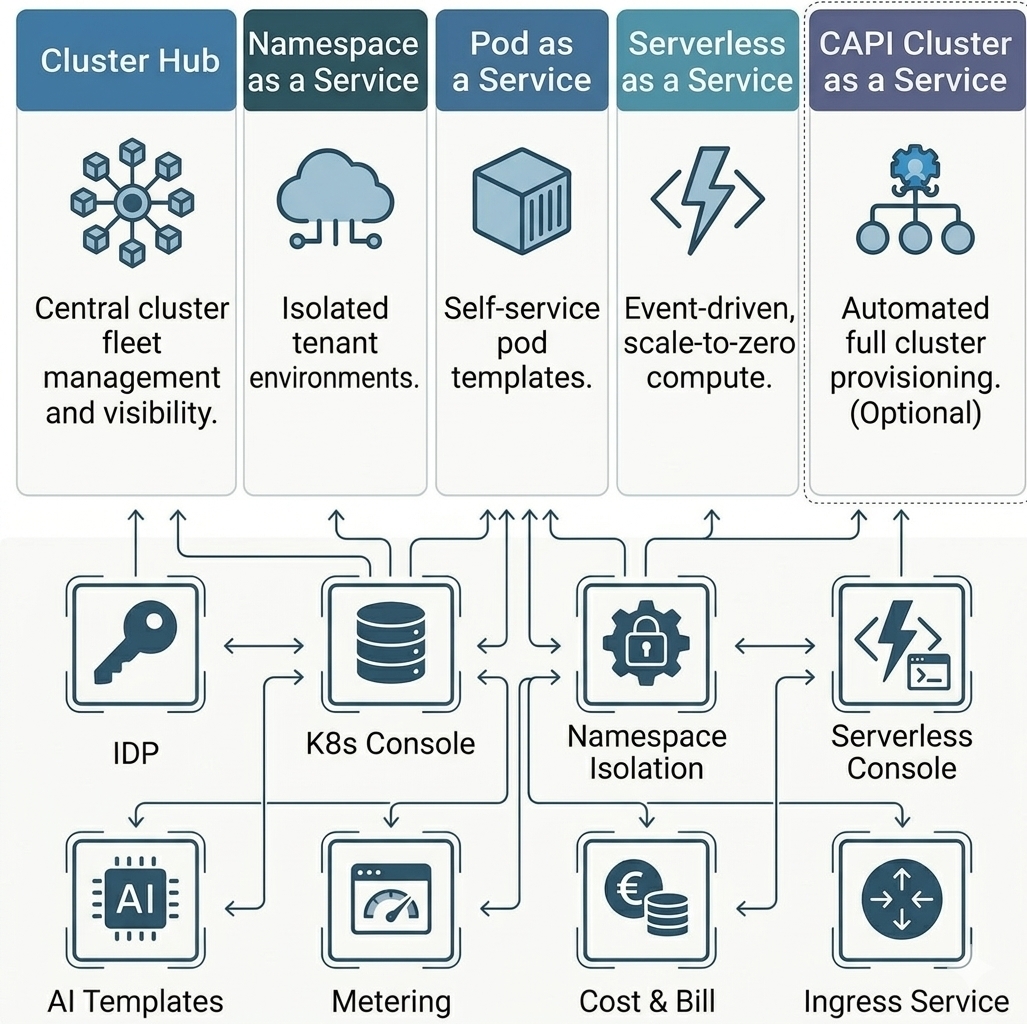
Morden Kubernetes offering has become complicated than ever: GPU Acceleration, cluster sprawling, complex applications, different compute providers, plain access to RBAC. Kubernetes has outgrown its inception as a mere container orchestrator, and purpose-built, multi-tenant Kubernetes management platform is now an operational necessity. For that, Uniview Kube Hub combines fleet cluster management, centralized access control, built-in tenant and namespace isolation, cost tracking, and advanced applications facilitated. Plug&Play API integration delivers instant multi-tenancy with zero risk or disruption to running clusters. It serves as a Kubernetes admin dashboard, too, as an alternative to Headlamp, and also purposedly built consoles for tenants when users of namespaces, servereless and pods are granted with partial access. An ultimate, deeply customizable multi-tenancy enterprise platform you don't want to miss.
Agentless Hub-and-Spoke Integration with Zero Cluster Changes
Uniview Kube Hub connects to subject clusters through standard Kubernetes API endpoints.
Because of agentless architecture, it relies on external state sync, instead of deploying CRD, binaries, custom operators, or sidecars onto your target control planes, and this makes it effectively working with one or many clusters in HUB mode.
We understand that injecting extra OIDC configurations or third-party CRD operator or agents into your control plane is a strict NO-GO for many enterprise production clusters.
Uniview is engineered to eliminate that exact operational overhead. Your target cluster configurations remain 100% untouched, interacting through secure API payloads only.
Uniview delegates necessary integrations as much as possible to decoupled platform, stead of within K8s control control plane.
Whether subject clusters are built on bare-metal, VMware Tanzu, or managed cloud services like Amazon EKS, Google GKE, and Azure AKS—Uniview delivers instant, uniform orchestration with zero target dependencies.
Advanced, High-Value Offerings: Pod-as-a-Service and Serverless Functions
Uniview is tailored for AI developers to deploy workloads easily,
even without Kubernetes knowledge, and economically with minute-based billing without concern of whole cluster.
To support this, Uniview provides ready-to-use AI workload templates for common needs—such as Ingress, application consoles, FTP, S3, and storage volumes—all in one place within an intuitive dashboard.
While no underlying Kubernetes knowledge is required, developers still get all the high-performance benefits that Kubernetes provides.
The same platform also supports alternative deployment models like virtual clusters or dedicated clusters, giving applications the capabilities they need to run successfully in shared environments.
Serverless as a Service: Achieving ultra-resource efficiency through serverless computing is straightforward, usable, and easy to understand with Uniview. We remove the typical abstractions, making serverless operations practical and manageable for daily development.
End-to-End Enablement for Namespace-Based Tenancy
Namespace-based tenancy is the most common isolation technique in Kubernetes, but setting it up has never been easy. Engineering it from scratch can be a long, difficult, and often frustrating process.
Common roadblocks:
Background noise and interference due to shared nodes;
lack of namespace console;
Complex governance and integration with other tools like vcluster or k3s;
timely and cost-reflective billing;
lack of namespace-level monitoring and logging, absence of self-service bootstrapping or simple admin tools to onboard tenants;
complex Ingress and CRD when namespace has limited permission.
Uniview addresses all above well and makes namespace-based tenancy controllable, repeatable, and straightforward, with namespace wide console, namespace-level logging and monitoring, self-service bootstrapping, predefined user policies, and namespace-based metering and billing.
Uniview makes it easy for need of dedicated nodes and ingress routing when extre manual setup is needed, or integrating CSP's own CI/CI setup. Out-of-the-box namespace isolation is fully ready, though network-level isolation remains outside the scope of Uniview.
Cloud-Grade IAM and Full User Management Console, No Manual Steps
The entire user onboarding lifecycle and self-service bootstrapping occur through the Console with zero manual steps.
This highly consistent, predefined user management schema ensures daily operations remain simple, repeatable, and robust.
Uniview Kube Hub is built on the same enterprise IAM foundation that powers the broader Uniview cloud platform. It directly addresses a long-standing limitation: while Kubernetes excels as a developer orchestrator, its native user management capabilities are inherently limited. Uniview bridges this gap by bringing familiar cloud identity concepts—including secure sign-in, organizations, automated onboarding, MFA, SSO, projects, granular roles, groups, and explicit quotas—into a unified model that behaves exactly as modern enterprise users expect.
K8s Dashboards Unified into a Single Pane of Glass for All
Uniview Kube Hub is a highly advanced Kubernetes dashboard, too, that provides fleet views of many clusters a user has access to, namespace dashboard, and seamless vCluster console when provisioned.
It's also console for advanced applications such as Runpod.io alike Pod As a service, managed Knative Serverless services etc.
Switching between these different views requires just a single click.
Unlike upstream Headlamp, which is built primarily for cluster administrators, Uniview is tenant-user centric too. It fits to the permissions of the logged-in user—whether they have multi-cluster access, read-only rights, isolated namespace scopes, or just access to a single pod.
Knative Serverless Simplified by Console: Offering complex services like Knative without a GUI is barely possible.
Uniview fills this gap by providing an accessible, understandable, usable, enabling developers to launch scalable, zero-replica apps with just a few intuitive clicks.
Pod-as-a-Service for AI factory by Console: One-click AI deployment by template, similar to Runpod.io, so that AI developers will never be tripped up by Kubernetes complexity.
Uniview conceals such infrastructure friction by providing a clean UI for AI developers to launch vLLM or complex ML models in minutes, automatically orchestrating GPUs, CPUs, networks, and data storage etc.
Enterprise Grade Metering and Cost Tracking
Uniview Kube Hub includes comprehensive metering collector that integrates with Kubernetes through standard kube‑exporters and NVIDIA DCGM Exporter. It correlates usage across namespaces, projects, users, and business units to produce accurate cost allocation, capacity insights, and efficiency dashboards.
Building on Uniview’s proven cloud‑rating engine, the platform performs periodic rating of collected events to generate near‑real‑time cost views within 48 hours, as well as full monthly billing summaries. When chargeback is required, Uniview provides a mature payment‑gateway integration, along with CSV export for internal cost distribution.
Uniview Metering is hassel-free, like OpenCost but even eaiser, only required is to have Prometheus installed in target cluster. Uniview automatically query data from and aggregate into enterprise cost view or CSV downloading.
Uniview provides metering solution for advanced service such as serverless, when they may live less than 1 minutes. Extra measure ensures no revenue loss occurred by such.
Thanks to the underlying Uniview cloud‑billing foundation, Kubernetes billing and cost management become a natural extension—reliable, transparent, and ready for enterprise or public‑cloud scale.
Uniview Kube Hub
Find answers to common questions about Uniview GPU Cloud, hybrid delivery, and billing.
Is there limit on number clusters or what required on subject cluster?
Uniview can work with any number of Kubernetes clusters, regardless bare-metal GPU cluster, AWS EKS, Azure AKS, OpenStack Magnum CAPI, GCP GKE, or OpenShift, or vLoft vCluster as long as CNCF confirming. Requirements on target cluster depends on what version of service to deploy, such as Knative serverless 1.22 requires hosting cluster to be minimum version 1.34, Kyverno v1.18 requires K8s v1.33.
What is essential needed to enable vLLM Pod as a Service?
vLLM is often the common workload over GPU infrastructure. Uniview provides Runpod.io alike model, by providing readiness of onboarding AI templates, so AI developers don't need K8s deep knwoledge, and over Uniview console, a few click user can get Jupyter env and data space with access to GPU to bring up their LLM. For operator, only needed is K8s cluster with GPU worker node ready. Adding to Uniview, tag it as GPU or specific GPU model such as H200, H100, then users can right way create their own vLLM AP applications.
How does Uniview handle tenant isolation?
Tenant isolation in Kubernetes is multi‑layered, not a single setting. Pod as a service users don't have underlying K8s API access, all requests authenticated by Uniview IDP. For namespace users, Uniview manages identity, organizations, projects, user‑to‑namespace mapping, tenant service accounts, role bindings, private node isolation, ingress isolation, and policy synchronization when drift occurs, and network isolation remains the responsibility of the CSP administrator. Dedicated Cluster users own the whole control plane without no isolation.
How SSO, IDP etc are integrated at Uniview?
Uniview provides flexible and robust identity integration. Enterprise IDPs such as Keycloak, Zitadel, and Entra ID can be configured easily with Uniview’s IAM module. Uniview then maps tenants and users to one or multiple Kubernetes service accounts for secure, consistent access control.
Is the platform scalable?
Yes. Uniview can manage any number of Kubernetes clusters, with no architectural limit. All components and underlying technologies scale horizontally by adding nodes and coordinating workloads.
What is needed to enable Serverless?
Uniview offers AWS Lambda alike user console to simplify process of Knative Serverless, and it has a justified boundary between image repository, code editing and build, then K8s function operation, eventing operations. Essential need is to have a K8s commonly version >=1.34, with knative installed, and tag it with 'knative', then that's it. Then user can immediately create their serverless function over Uniview.
See Uniview Kube Hub in your environment.
Uniview is developed by medium business, but it has big vision realized. At a beta version stage, we appreciate any reach out for collaboration, joint effort and testing.
Talk to us
Tell us about your inventory, requirements or any suggestion. We’ll propose a rollout that works best to you.