GPU Kubernetes infrastructure demand has skyrocketed, yet building and operating shareable GPU environments remains difficult and inconsistent. Hardware changes quickly, drivers evolve, easy‑to‑use AI workload deployment is still hard to achieve, and orchestration models shift rapidly. Shared GPU infrastructure is especially valuable for its agility, high GPU utilization, fast time‑to‑market, and zero provisioning overhead for tenants. But because Kubernetes was never designed with multi‑tenancy in mind, transforming it into a shared GPU platform is inherently challenging.
Beyond the challenges of shared Kubernetes infrastructure, AI workloads introduce their own complexity. Successfully deploying and running advanced AI applications inside another complex Kubernetes cluster is far from straightforward. In‑depth Large Language Models, data‑science pipelines, and intricate K8s DevOps all converge, turning application deployment into a daunting, months‑long cycle of trial and error. A purpose‑built developer‑oriented cloud is therefore highly desired to address the collision of these two complex stacks.
Multiple solutions exist today: a pod platform where without k8s devops skillset, AI developers are faciliated with templates, ingress, and secrets to deploy AI application by nearly one‑click; a multitenant Kubernetes cluster with isolation by namespace, virtual cluster, networking boundaries, and dedicated nodes; and finally, dedicated clusters—either bare‑metal GPU pod clusters or VM‑based GPU passthrough clusters. Each approach is critical for business offerings and fits a specific use case well.
However, technical solutions on the market remain fragmented. AI workloads evolve rapidly, and no single business model can meet all needs. Each scenario has distinct pros and cons, as seen in platforms such as Runpod.io, vCluster, Capsule, and Kamaji. This post describes the problem space, outlines the technical and business challenges, and explains how Uniview—an established enterprise cloud platform—has been extended to support all three models under the same user base and the same console: one‑click Pod applications, namespace‑isolated multitenant cloud, bare‑metal GPU pod clusters, and VM‑based GPU passthrough clusters. The goal is to provide an agile, high‑performance GPU cluster offering that balances usability, security, and operational consistency.
The problem space of GPU‑centric Kubernetes infrastructure
GPU infrastructure today is Kubernetes‑centered, yet deploying AI workloads on Kubernetes remains costly and complex. Kubernetes is the de‑facto platform for AI, but LLMs, data pipelines, and modern AI applications all carry a steep operational curve. It's far beyond Kuberentes itself
Kubernetes is an orchestration system, not a cloud platform. Successful AI deployment requires professional DevOps expertise, and building a shared, multitenant Kubernetes environment on top of it is even harder. Common need of Developers include such templates, automation, ingress and predictable deployment flows that can hide the complexity of Kubernetes; a raw cluster is not enough. As AI shifts into the inference era, the difficulty of deploying AI and data workloads onto Kubernetes becomes a major barrier.
Multitenant Kubernetes exposes further limitations. Dedicated GPU infrastructure is expensive, while shared cloud offers agility — yet Kubernetes provides none of the platform‑level capabilities needed for a GPU cloud: shareability, multi‑tenancy, billing, cost allocation, user consoles, and workload utilities must all be engineered externally.
Bare‑metal GPU clusters deliver maximum performance but remove VM abstractions, forcing the platform to manage GPUs directly. Scheduling, isolation, and multi‑tenancy become significantly more complex. GPU utilization becomes a critical business metric; high utilization requires strong orchestration and shared infrastructure. Hardware features like NVIDIA MIG help, but platform‑level challenges remain.
The ecosystem is fragmented — tools like OpenCost, Kubecost, Runpod, RunAai, vCluster, OpenUnison, Loft, KAI Scheduler, and Kubeflow each solve only one part of the GPU‑cloud puzzle.Stacking these solutions often leads to inconsistency, vendor lock‑in, and integration challenges. Choosing the right architecture becomes critical.
With these issues in mind, Uniview Pod Hub is designed to close the gap by unifying orchestration, governance, tenancy, and billing into a single enterprise platform — built for consistency, sustainability, and developer‑oriented usability.
Design principles behind Uniview Pod Hub
Uniview Pod Hub is built around five core principles that define how the platform behaves, integrates, and scales in shared GPU infrastructure. These principles come directly from real‑world GPU‑cloud engineering and the gaps seen across fragmented solutions.
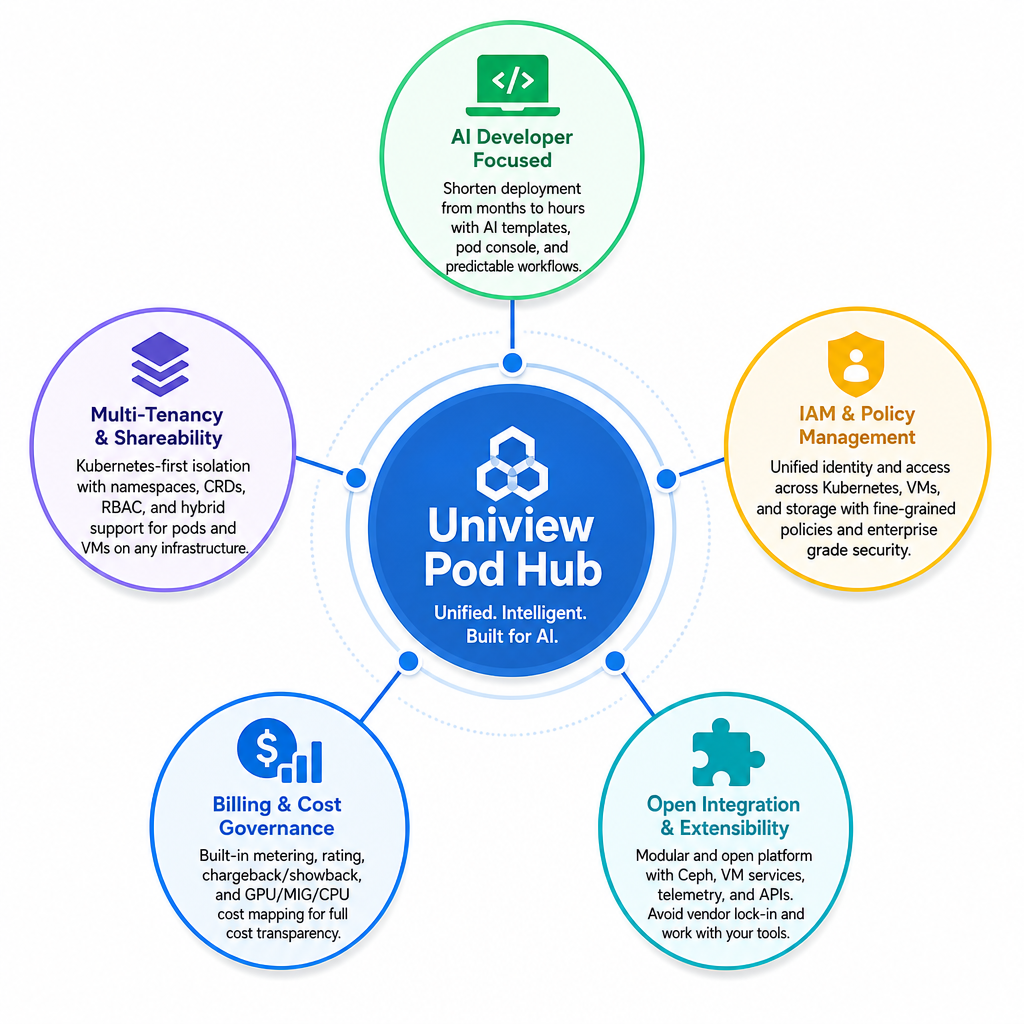
AI workloads do not simply expect GPU compute; they expect a platform that reduces deployment cost and operational friction. Uniview Pod Hub shortens AI deployment from months to hours by abstracting infrastructure and providing developer‑facing features such as pod consoles, AI templates, and optional namespace consoles. A GPU cloud is only as usable as its interfaces. Uniview delivers clean pod consoles, AI application templates, and an operator dashboard, interoperating with NVIDIA device plugins, Run:ai, and existing cloud investments. The goal is a consistent, predictable workflow without exotic user experiences.
Uniview Pod Hub uses Kubernetes as the primary orchestration surface, aligning with the industry trend of Kubernetes‑first AI tooling. It leverages namespaces, CRDs, RBAC, and device plugins while also supporting VM GPU passthrough and OpenStack‑based clusters. This allows organizations to run bare‑metal GPU pods, VM‑based GPU workloads, or hybrid models without forcing a single deployment pattern.
Identity is the anchor of a multi‑tenant GPU cloud. Uniview Pod Hub provides a unified identity, policy, and permission layer that defines who can access which GPUs, when, and under what conditions. This consolidates onboarding, quota enforcement, access control, and auditability across Kubernetes, VMs, and storage — eliminating inconsistent per‑tool IAM models.
GPU clouds require transparent cost visibility. Uniview Pod Hub integrates metering, cost allocation, invoicing, and payment flows directly into the platform. It meters GPU time, memory, MIG slices, ephemeral storage, and Kubernetes resources to provide accurate chargeback and showback — enabling sustainable business models and predictable tenant budgeting.
The platform is intentionally open and modular. Uniview Pod Hub integrates cleanly with the AI ecosystem: Ceph block and object storage, VM services, cluster consoles, telemetry collectors, dashboards, and observability stacks. It avoids proprietary workflows and instead provides the context and APIs needed for developers, platform engineers, and finance teams to plug in preferred tools. This prevents vendor lock‑in and supports long‑term architectural flexibility.
What Uniview Pod Hub provides
AI Workload Template onboarding, Ingress and Tools Facilitating Uniview has form pattens that guide most AI workload need for success of deploying to Kubernetes. It contains common need such as data console, CLI console, SSH console, ready ingress of inteference endpoint and web endpoint, so that user literally don't need knowledge of Kubernetes, while still can on-click deploy common LLM or inferrence workload. Proocess are well faciliated by wizards. Data scientists and AI developers is not ncessary to have in-depth kubernetes or infrastructure skill for successful deploying high performance GPU workloads.
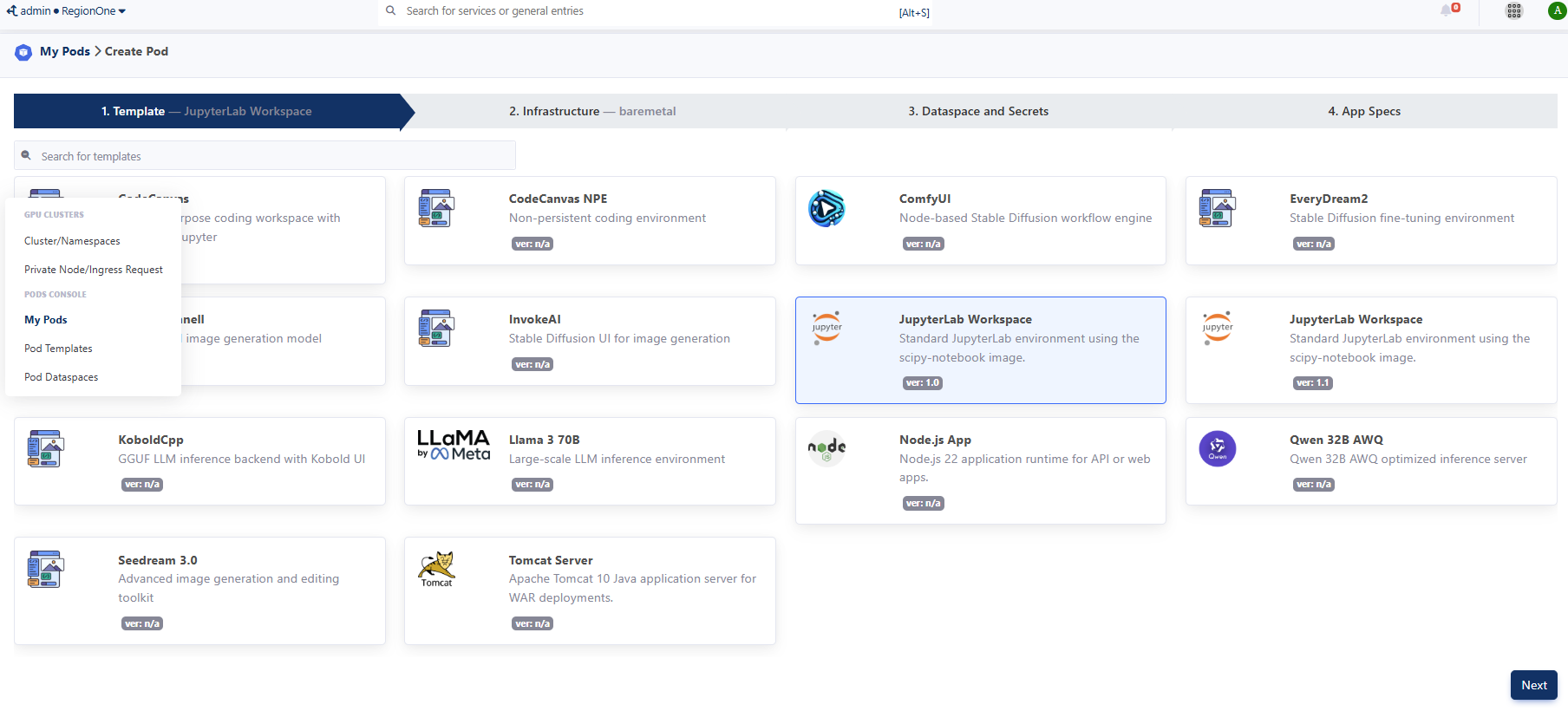
Unified control plane for high desirable AI infrastructure modes: PoD user console, virtual cluster console, and dedicated clsuter console Uniview Pod Hub delivers a single management layer that exposes GPU inventory, tenancy mapping, and policy controls across bare‑metal pods, VM passthrough, and Kubernetes clusters. This unified plane eliminates fragmented tooling and provides consistent visibility and governance across all deployment models. It's worth to say Uniview user console integrates monitoring dashboards, such as namespace level, pod level CPU, Ram, Network traffic etc.
Identity and access management A centralized IAM system defines who can access which GPUs, when, and under what conditions. Role‑based access, project constructs, and audit trails ensure accountability. Integration with enterprise identity providers enables single sign‑on and consistent tenancy mapping across Kubernetes and OpenStack environments.
Per‑resource metering and billing Fine‑grained metering covers GPU, CPU, RAM, and storage usage. Cost models support per‑GPU pricing, spot or preemptible rates, and custom chargeback rules. Built‑in dashboards and exportable reports enable finance reconciliation and automated invoicing, turning GPU operations into measurable business units.
Multi‑tenancy and cluster slicing Cross‑layer isolation combines namespace controls, network segmentation, and hardware reservation. Tenant slices are enforced across management, compute, and networking layers, enabling secure, predictable multi‑tenant operation without sacrificing performance.
Private Node and Private Ingress
Uniview supports private node isolation, allowing sensitive workloads to run on dedicated nodes without interference from other tenants. Projects can safely operate across designated nodes, ensuring noise‑free performance and stronger security boundaries.
Node flavor at Uniview helps CSP to standardize underlying node spec, to facilitate understanding and rating as well.
Uniview also provides private ingress capabilities using common technologies such as Istio. A tenant‑specific gateway prevents uncontrolled proliferation of load balancers or node IPs, while shared gateways remain secure and centrally governed.
OpenStack and VM passthrough support Native connectors for OpenStack projects and VM GPU passthrough workflows allow enterprises to reuse existing VM fleets while gaining Kubernetes‑style orchestration, unified billing, and governance.
Architecture and integration patterns
Control plane components The API and policy layer exposes tenancy, billing, and scheduling policies. Scheduler adapters translate high‑level policies into Kubernetes scheduling constraints and VM placement decisions. A telemetry pipeline ingests GPU metrics, normalizes vendor data, and feeds billing and observability subsystems. The billing engine aggregates usage, applies pricing rules, and generates reports and invoices. Console and UX components surface role‑specific views for developers, platform engineers, and finance teams.
Interoperability Uniview integrates with NVIDIA device plugins, common CNI plugins, Prometheus exporters, and enterprise identity providers. The platform exposes APIs for integration with existing ticketing, CMDB, and billing systems, ensuring smooth adoption into established enterprise ecosystems.
Differentiation versus other AI and Kubernetes platforms
Runpod.io is a leading AI‑developer‑oriented cloud. Uniview Pod Hub shares the same philosophy by providing ready templates, guided onboarding, and a streamlined deployment process. Both platforms enable AI developers to deploy common workloads easily — often in one click — without Kubernetes expertise or a dedicated DevOps team. Both can accommodate new templates a CSP introduces. The key difference is that Uniview is a software platform for CSPs to operate their own AI infrastructure with agility, whereas Runpod is a hosted service, not a deployable software solution.
vCluster and Loft are popular virtual‑cluster technologies. Uniview Pod Hub provides equivalent namespace isolation, tenancy, and governance. For enterprise non‑production workloads, vCluster remains an excellent tool — and Uniview integrates with vCluster (open‑source or enterprise) as a provisioning layer for virtual clusters, combining flexibility with enterprise‑grade policy and control.
OpenCost and Kubecost are widely used for Kubernetes cost visibility. Uniview Pod Hub goes further by introducing per‑namespace and project‑based mapping for GPU, CPU, and RAM usage. Its integrated rating engine and data collectors feed directly into the billing cycle, enabling automated chargeback and transparent cost allocation — moving beyond visibility into actionable financial governance.
For identity and access management, OpenUnison is often referenced for user and session management. Uniview Pod Hub provides comparable IAM capabilities but extends them across Kubernetes, OpenStack, and VM layers, ensuring consistent identity enforcement across the entire infrastructure stack rather than per‑tool IAM silos.
The key differentiation is that Uniview Pod Hub unifies all these dimensions — orchestration, IAM, billing, multi‑tenancy, and developer experience — into a single cohesive platform. Instead of relying on a stack of separate tools, Uniview provides one pane of control designed for both technical and business continuity. Further comparisons and benchmarks are available through our industry publications and technical blogs.
Conclusion and next steps
GPU infrastructure is a strategic yet costly resource. Enterprises need more than a scheduler or a cost dashboard — they need a control plane that unifies orchestration, governance, and finance. Uniview Pod Hub delivers that control plane by combining Kubernetes‑native scheduling, VM and OpenStack compatibility, centralized IAM, and built‑in billing. The result is a GPU cloud that is easier to operate, easier to monetize, and safer to share across teams and partners.
Call to action: Evaluate Uniview Pod Hub with a short pilot focused on tenancy mapping and billing. Start with a single cluster and a representative set of workloads to measure utilization gains, validate chargeback flows, and prove the integration path to your existing infrastuctures.
Authored by Admin · At Toronto July 2026