
Geographically distributing workloads across multiple sites has traditionally been viewed as something only hyperscalers like AWS, Azure, and GCP can deliver. This perception exists for good reason: running applications across regions with consistent identity, synchronized state, and reliable workload mobility requires significant engineering effort and operational maturity.
There have been attempts to bring similar capabilities into the OpenStack ecosystem. However, in real‑world deployments, most multi‑site or multi‑region OpenStack solutions remain conceptual. They rarely reach production due to high complexity, cross‑site coupling, and the operational cost of maintaining shared services across distance.
Let’s look at the common use cases that drive multi‑region deployments:
- Disaster Recovery and Business Continuity
- Global Performance Optimization
- Data Sovereignty and Compliance
- Cost Optimization Through Geographic Arbitrage
And the typical patterns of geo‑distributed workloads:
- Active‑Passive (DR‑focused)
- Active‑Active (performance‑focused)
- Geographic Distribution (compliance‑focused)
How Uniview Fits Into Classic Multi‑Region Patterns
Before exploring the six key capabilities of Uniview’s shared‑nothing model, it’s important to clarify one thing: Uniview does not replace the classic OpenStack multi‑region patterns — it supports all of them. Operators can continue using:
- Shared Keystone (multiple regions sharing a central identity service)
- Federated Keystones (regions linked through federation protocols)
- Hybrid models (some shared services, some independent)
These models remain valid and are fully compatible with Uniview. However, they also come with well‑known limitations: cross‑site coupling, version lockstep, shared database fragility, and operational overhead.
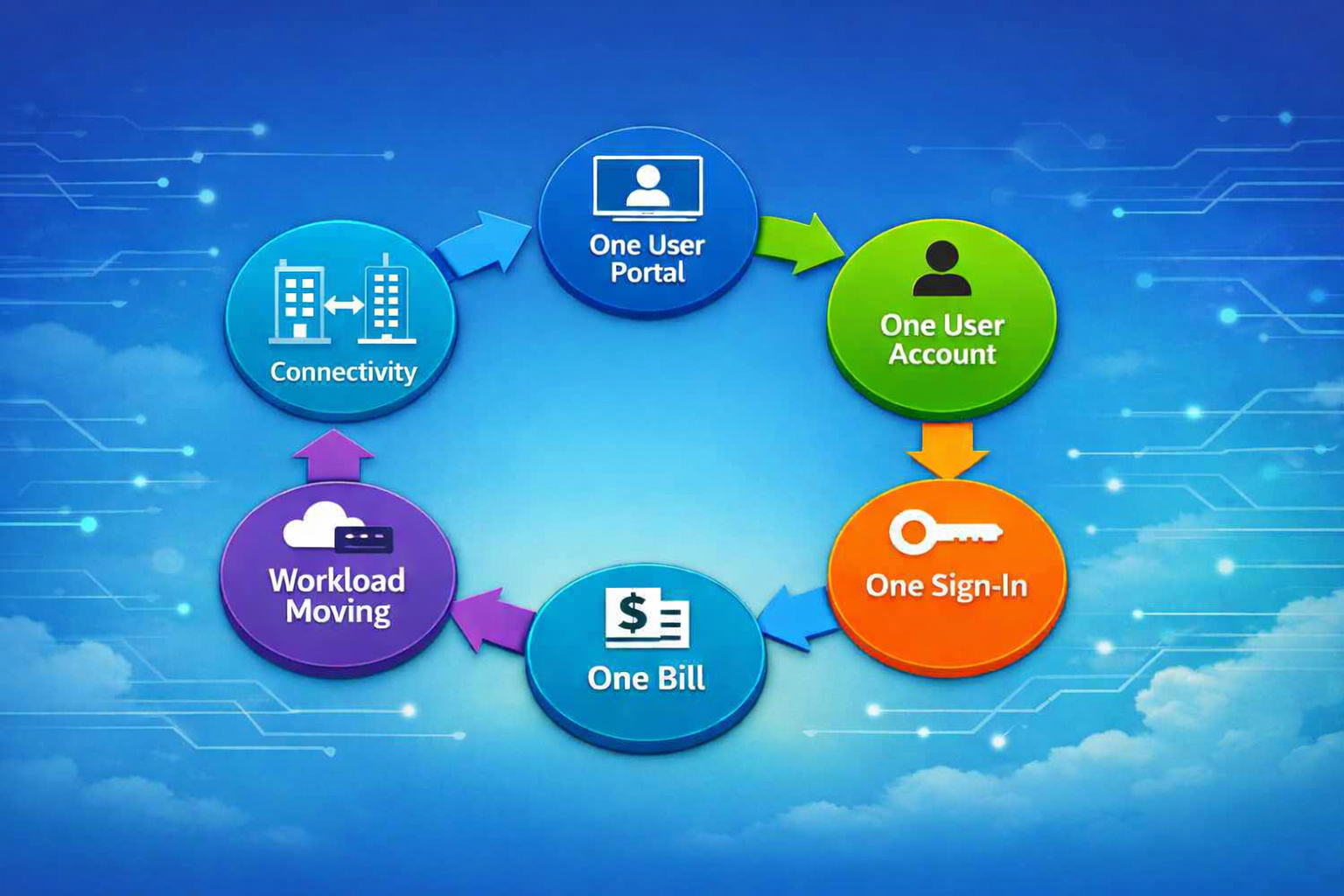
This is where Uniview introduces something new: a shared‑nothing multi‑site architecture that avoids the pitfalls of classic multi‑region OpenStack while enabling true geo‑distributed workloads. This architecture is built on six key building blocks:
- One User Account
- One User Portal
- One Sign‑In
- One Bill
- Workload Mobility Between Sites
- Optional (Not Required) Inter‑Site Connectivity
Together, these capabilities allow operators to run multiple independent OpenStack clusters — each with its own controllers, databases, and storage — while presenting them to users as a single, unified, geo‑distributed cloud.
One User Account
A geo‑distributed cloud is not truly unified if users must maintain separate accounts in each region. Multiple logins fragment the experience and turn “multi‑site” into isolated silos.
How Uniview helps: Uniview provides a unified identity layer across all OpenStack sites. A central region can serve as the identity authority, or Uniview’s built‑in IDP can provide SSO. Uniview maps the unified identity to each site’s local Keystone account, but these per‑site accounts remain completely hidden from the user. See further Uniview identity solution, see related blog
One User Portal
Just like identity, the user interface must be unified. If users must switch between different Horizon dashboards or region‑specific portals, the cloud becomes operationally fragmented.
How Uniview helps: Uniview offers a single, unified portal that spans all regions. Users access all workloads from one URL. The portal handles region selection, token mapping, and service endpoint routing automatically, ensuring a consistent experience across sites. More details about Uniview User Console, see related blog
One Bill
For public cloud operators and enterprise chargeback models, billing must be consolidated. If users receive separate bills for Region A and Region B, the cloud is not truly multi‑site.
How Uniview helps: Uniview aggregates usage and cost data across all OpenStack clusters. Users receive one invoice and one usage summary, regardless of where workloads run.
Moving Workloads Between Sites
Multi‑region infrastructure only becomes meaningful when workloads can move between sites. Without mobility, regions are simply isolated datacenters.
How Uniview helps: Uniview enables one‑click workload mobility. Users can move or clone instances across regions, replicate VM state, and perform cross‑site failover. This supports disaster recovery, redundancy, and performance‑based placement.
Recommended but Optional Inter‑Site Connectivity
Dedicated fiber or private WAN links are ideal but expensive. Many assume multi‑site OpenStack requires low‑latency, high‑bandwidth connectivity.
How Uniview helps: Uniview is designed to operate effectively even without dedicated inter‑site links. It safely uses the public internet for authentication, metadata synchronization, and workload replication. Each OpenStack site remains an autonomous environment with its own security perimeter. Because Uniview does not rely on cross‑site database replication or frequent token synchronization, latency across the public internet does not degrade the user experience.
Conclusion
Multi‑region and multi‑site capabilities are becoming essential differentiators for modern cloud infrastructure. Shared‑nothing OpenStack clusters offer the best combination of resiliency, simplicity, and cost efficiency. Uniview is engineered specifically for this model — providing one account, one portal, one sign‑in, one bill, and seamless workload mobility across sites. It transforms multiple independent OpenStack clusters into a unified, geo‑distributed cloud.
Authored by ComputingStack · At Toronto April 2026