Kubernetes has solidified its position as the default container orchestration platform across the global tech landscape. It is dominiating interface to majority of AI workloads too. At the same time, OpenStack remains the primary sovereign infrastructure technology powering clouds in Europe, Asia, Canada, and very much world out side of US. And even within US, OpenStack is the core underyling infrastructure of enterprise, where data sovereignty may not be the primary driver. With VMware exit from market as most recent move, OpenStack is one of the stongest contender too to fill the space left by VMWARE exit. Determining how Kubernetes is effectively offered alongside or partially along side with OpenStack is both technical foundation, and also a criticl business viability consideration.
Numerous online resources clarify this architectural intersection, notably the official OpenStack documentation: Leveraging Containers and OpenStack . This blog, however, steps back to evaluate these options from a strictly enterprise-driven angle. We will outline the primary delivery models by examining what practical engineering actions you must execute, where your capital funding must be spent, and how your software procurement budget scales across each complexity matrix.
Enterprise Building Block
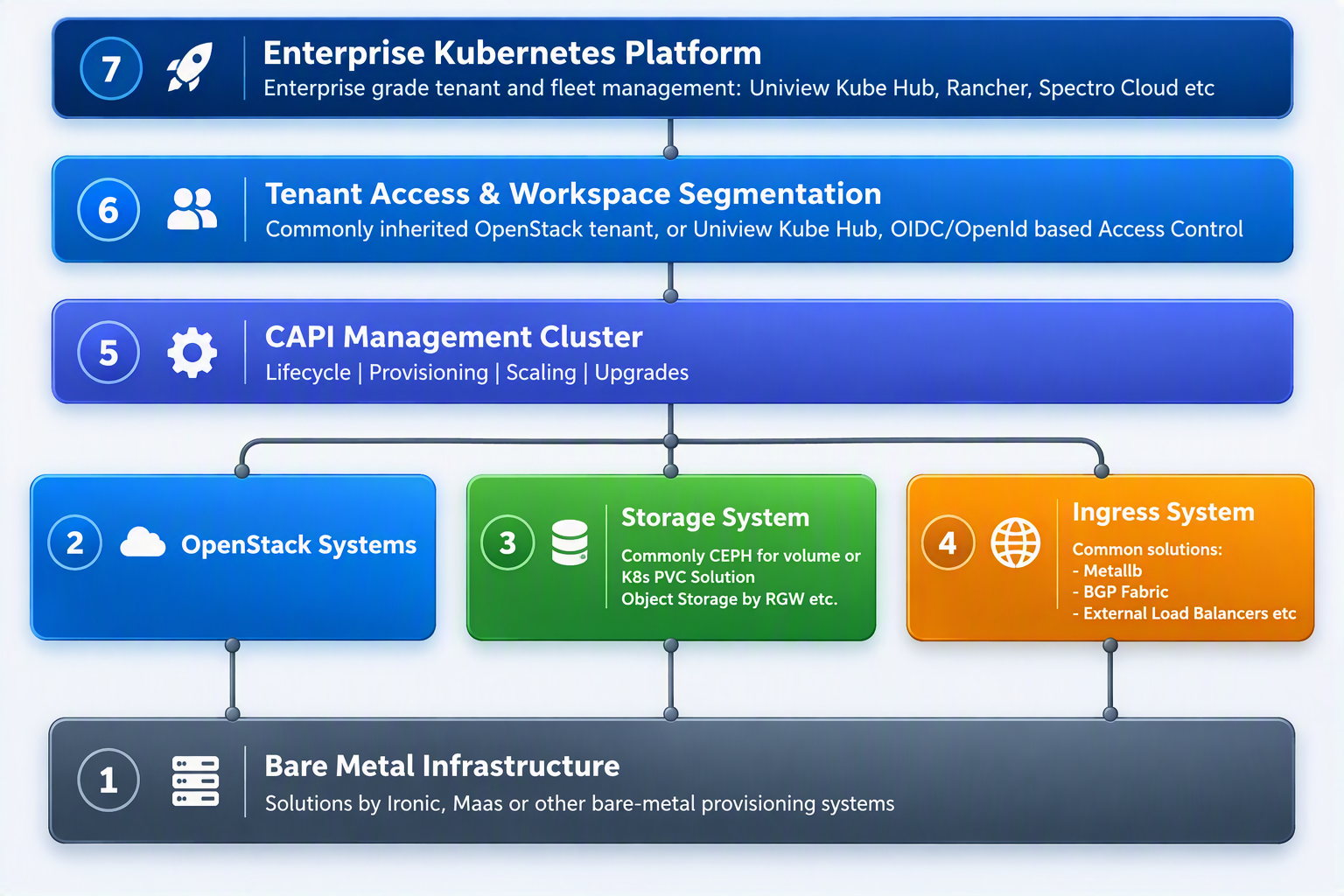
When engineering an enterprise container platform, by technology ecosystem, solution provider, or procurement, several building blocks must be addressed structurally. They are listed as both on business wise they are likely by a solution of open source or a provider, and a rather independent ecosystem behind, technically they are relatively independent. Such as baremetal management, it can represent a critical technical choice and provider choice by OpenStack Ironic, Canonial zuul etc. Over Ironic or Canonical Zuul, either Kubernetes or OpenStack can be installed with readiness of baremetal. The building block is grouped as below:
-
Bare-Metal Management Solution Physical host provisioning, lifecycle management, that common solution such as OpenStack Ironic (Standalone), or Canonical MaaS etc. When Kubernetes Infra is planned in an organization, physical layer to build yourself or outsourcing to external cloud providers, then this can be optional.
-
OpenStack systems The Whole openStack system including Magnum is very strong underlying for Kubernetes service. Indeed the investment on things around OpenStack is one time. For example if OpenStack is fully ready, which will require storage, bare metal, network, then there is no extra need for kubernetes setup to consider.
-
Software-Defined Storage (SDS) Storage and PVC orchestration for Kubernetes is a must. Without a dedicated storage solution, Kubernetes cannot run. Because standard public cloud offerings dominate the market, the importance of storage is often overlooked. In this layer, Object storage is often a must-have for modern Kubernetes and AI infrastructure. Often RGW by Ceph or other ready commercial systems are possible.
-
CAPI Management Cluster The CAPI management cluster is a permanent setup that requires high reliability. Losing the management cluster often implies the failure of downstream clusters. Fortunately, the management cluster is lightweight, but maintaining a highly available hosting topology and operational resilience is critical. It can be bootstrapped via kubeadm or hosted externally with reliable backups.
-
Bare-Metal Ingress Networking Ingress is a critical component for on-premises Kubernetes when a cloud provider is absent. Without help from Cloud Providers of AWS/GCP/OpenStack, the command solutions include MetalLB, BGP Fabric, Enternal Load Balancers etc must be engineered.
-
Tenant and Enterprise Oriented Cluster Access A structural choice defining whether cluster boundaries are inherently "tenant-ready" or flatly "administrator-ready" at the infrastructure tier. The common solution at this engineering blocks often go to OpenStack tenant ( if magnum, tenant will be inherited from OpenStack), or other OIDC, Uniview Kube Hub systems that must be hooked up to manage who and what to access within an organization.
The Distinction: Under an OpenStack Magnum architecture, clusters are natively tenant-ready out of the box by mapped OpenStack tenants under the hood. Conversely, Bare-Metal and CAPO architectures provision flat, administrator-focused layouts where tenant ownership is never natively defined. Consequently, an independent layer of enterprise access control must be engineered or procured to enable secure, controllable access. -
Kubernetes Enterprise Platform An enterprise platform ensures that provisioned Kubernetes clusters are fully manageable and auditable from an organizational standpoint. This layer typically involves Enterprise Access Control (RBAC), quota management, cost allocation management, multi-tenancy boundaries, and governance across disparate clusters. Implementing this requirement usually necessitates a market solution, an open-source framework, or a self-engineered access control platform.
Enterprise Kubernetes Journey: Bare-metal or Stacked over OpenStack etc
An organization's Kubernetes journey generally navigates one of five primary architectural tracks: Path 1: Bare Metal deployments (via open-source utilities or OpenShift); Path 2: OpenStack Magnum, a turn-key solution; Path 3: Cluster API with OpenStack Providers (CAPO); Path 4: Hyperscaler Public Clouds (AWS, GCP, Azure); or Path 5: Niche virtualization engines like VMware Tanzu. This analysis focuses strictly on Paths 1 through 3. Public cloud offering, is generally robust and represents a strategic procurement decision rather than a foundational platform engineering challenge.
Path 1: Kubernetes Directly on Bare Metal
The first approach bypasses OpenStack entirely and deploys Kubernetes directly onto physical infrastructure. This model commonly uses Cluster API with Metal3, Tinkerbell, or custom provisioning systems combined with kubeadm-based bootstrap providers.
Enterprises are responsible for networking, load balancing, ingress exposure, storage orchestration, firmware lifecycle management, server inventory, operating system management, and cluster lifecycle operations.
Advantages
- Maximum hardware utilization.
- No hypervisor overhead.
- Strong alignment with upstream Kubernetes communities.
- Reduced software stack complexity.
- Excellent performance for AI, HPC, and latency-sensitive workloads.
Disadvantages
- Storage integration becomes significantly more complex.
- Multi-tenancy must be implemented separately.
- Hardware lifecycle management remains difficult.
- Cluster replacement often involves physical state cleanup.
- Chargeback models are harder to establish.
This architecture is often preferred by organizations prioritizing performance over self-service.
Path 2: Kubernetes Through OpenStack Magnum
Magnum provides Kubernetes as a first-class OpenStack service. Users interact with OpenStack APIs and workflows to provision managed Kubernetes clusters within their own projects. Networking, identity, storage, DNS, and load balancing are automatically integrated with existing cloud services. From the consumer perspective this resembles the experience provided by EKS, AKS, or GKE.
Advantages
- Native multi-tenancy.
- Excellent integration with OpenStack services.
- Simplified tenant experience.
- Integrated billing and quota models.
- Strong infrastructure governance.
Disadvantages
- Depends heavily on the OpenStack ecosystem.
- Less flexibility than direct Cluster API implementations.
- Organizations remain tied to Magnum's lifecycle model.
- Less portability toward non-OpenStack environments.
Magnum excels when the organization views Kubernetes as another cloud service alongside virtual machines, storage, and networking.
Path 3: Cluster API Provider OpenStack (CAPO)
CAPO represents the architecture increasingly adopted by modern platform engineering teams. Instead of treating Kubernetes as an OpenStack service, OpenStack becomes an infrastructure provider consumed by Cluster API. The management cluster owns lifecycle operations while OpenStack simply allocates the necessary infrastructure resources.
Advantages
- Fully declarative infrastructure.
- Strong GitOps compatibility.
- Cloud portability.
- Excellent cluster disposability.
- Strong alignment with upstream Kubernetes strategy.
Disadvantages
- Requires management cluster operations.
- Additional platform engineering skills are needed.
- Tenant self-service often requires an additional portal layer.
- Financial reporting usually requires supplementary tooling.
CAPO is particularly attractive when organizations want to standardize cluster lifecycle management across multiple infrastructure providers.
Comprehensive Building Blocks Required Matrix
The following matrix breaks down exactly what you must build and manage yourself versus what you can fully offload to a vendor.
| Building Block | Kubernetes over Baremetal (In-House) | Kubernetes over OpenStack Magnum | Kubernetes over OpenStack (CAPO) |
|---|---|---|---|
| 1. Bare-Metal Infra | You Build Everything All baremetal level solution and provisioning. |
You Build Everything All baremetal level solution and provisioning. |
Vendor Handles It Fully offloaded on openstack provider. |
| 2. OpenStack Systems | Not Needed |
You Build Everything Massive cost. You must engineer and support the entire OpenStack cloud framework internally. |
Vendor Handles It Fully offloaded. Small businesses consume a pre-built OpenStack environment via APIs. |
| 3. Ceph Storage | You Build Everything Must engineer, deploy, and scale a dedicated storage cluster (like Ceph) for Kubernetes. |
You Build Everything Heavy cost. You must design and scale the private cloud's core backend storage (Cinder). |
Vendor Handles It Fully offloaded. Volumes dynamically map straight to the third-party provider's storage layer. |
| 4. CAPI Management Cluster | You Build Everything Dedicated overhead to run permanent management nodes driving your physical target servers. |
You Build Everything Required. Behind the Magnum API, you must run a backend CAPI engine to deploy tenant clusters. |
You Build Everything Required. Small businesses must run a small, lightweight client-side management cluster. |
| 5. Bare-Metal Ingress Networking | You Build Everything High complexity tying physical switches and network hardware directly to Kubernetes. |
You Build Everything Heavy cost. Requires your team to manually set up cloud software networking (Neutron/Octavia). |
Vendor Handles It Fully offloaded. Natively utilizes the pre-configured third-party cloud load balancers. |
| 6. Tenant & Enterprise Oriented Access | Flat / No Tenants Administrator-flat. No native tenancy exists; total reliance on separate software wrappers. |
Tenant-Ready Built-in isolation. Clusters owner inherits OpenStack multi-tenancy. |
Flat / No Tenants The cluster itself is flat. Internal user isolation must be added downstream by you. |
| 7. Kubernetes Enterprise Platform | Software Required Requires Uniview Kube Hub or Rancher to slice up flat capacity safely for users. |
Optional Overlay Used strictly if you need advanced day-2 application governance (like Uniview Kube Hub, Rancher). |
Software Required Requires an access wrapper platform to securely share leased cloud resources with teams. |
Conclusions
Technically Kubernetes is a dominating container orchestration engine but not multi-tenant ready. OpenStack is an enterprise platform with excellent tenant facilitation. Kubernetes as a single instance—commonly seen via kubeadm, k3s, EKS, or GKE—is easier for the end-user. In reality, setting up an enterprise platform is not necessarily easy or low-cost. On adoption patterns, there is no universally correct architecture for delivering Kubernetes over OpenStack. All three patterns listed in this blog are actually stable, mature, and proven by major use cases. For a business, the right answer often depends on organizational priorities, culture, financial governance requirements, and long-term platform strategy. Here are some verdicts for common use cases:
Re-cap the three frameworks
Let's summarize the three major architectural patterns:
Bare-Metal Kubernetes maximizes performance and minimizes layers. Enterprise end-to-end setup has strong references from market, but also with massive variations that lead to many uncertainty. For hyperscalers or telecommunication providers—often with a massive footprint—the ability to easily spread the operational costs of raw bare metal and specialized storage across scale makes this model a primary consideration. When performance is the top requirement, this will be the preferred option as well, such as for high-performance computing powered by GPUs.
OpenStack + Magnum is a turn-key solution for Kuberentes. It maximizes user convenience and OpenStack integration. Its operational footprint is elegant: nearly everything runs directly within the native OpenStack ecosystem, providing out-of-the-box Kubernetes. From a business and procurement standpoint, this fits medium-to-large organizations exceptionally well, eliminating immediate dependency on separate enterprise suites like OpenShift, Rancher, or Spectro Cloud.
CAPI + OpenStack (CAPO) maximizes lifecycle automation, GitOps workflows, and delegate the baremetal and virtual resource part to a 3rd cloud ecosystem such as OpenStack or AWS. For medium-to-large businesses architecting for true multi-cloud portability—where OpenStack, AWS, and GCP are all simultaneous targets—leveraging CAPI as a standardized abstraction layer acts as the ideal structural pattern.
Then let's examine a few most common business use cases:
If I am a Small to Medium Business
For small to medium businesses, often both labor and funds are constraints. In this case, surprisingly, Kubernetes over bare metal isn't necessarily the easy path. Rather, a turn-key solution from open-source OpenStack+Magnum has better viability as a unified ecosystem, where Kubernetes is ready out of the box and the ownership model is multi-tenant ready. For a small team, it is totally achievable to get a decent enterprise platform with high availability and backups in place at ease. In contrast, bare-metal Kubernetes involves composing volume storage solutions, object storage, ingress networking, backups, and high availability, introducing a lot of in-house engineering velocity changes with huge uncertainties. Furthermore, without paying for a commercial platform, a vanilla Kubernetes platform remains single-tenant—meaning it is only ready for a single administrator.
If for high performance, GPU compute and AI workloads
For the sole reason of high performance, bare-metal Kubernetes will be the best option. When there is no hypervisor layer, instances perform obviously better.
When I have large scale, or am a hyperscaler
Going over bare metal will concentrate engineering resources on Kubernetes itself to deliver unique competencies. Because of the large scale, all engineering or expenditures on software-defined volume storage, object storage, ingress networking, and enterprise management platforms are spread thin on a per-unit basis. Often, having OpenStack in between doesn't help too much, and instead serves to distract core engineering teams.
Ultimately, successful platforms are not defined by Kubernetes alone. They are defined by how effectively infrastructure, storage, networking, automation, security, governance, and financial accountability work together as a cohesive operating model.
How Uniview Empowers the Enterprise Kubernetes Vision with or without OpenStack
Originally built as a premium user console and billing engine for OpenStack, Uniview has evolved into a deeply Kubernetes-centralized management plane. This hybrid lineage makes Uniview uniquely equipped to accelerate enterprise cloud-native transformations. Whether deployed as a standalone orchestrator via Uniview Kube Hub or stacked on top of an existing OpenStack investment, the platform solves the foundational challenges of enterprise multi-tenancy, visibility, and cost governance.
Operationalizing OpenStack Magnum
Uniview elevates the native Magnum experience into an enterprise-grade cloud portal:
- Comprehensive Magnum Console: Enables tenants to seamlessly provision, scale, and lifecycle-manage Kubernetes clusters through an intuitive GUI.
- Unified Cluster Access: Integrated tenant dashboards allow authorized users to securely launch native Kubernetes consoles straight from the OpenStack UI with a single click.
- Cluster-Wide Multi-Resource Billing: Driven by a powerful, dual-stack metering engine, Uniview stands alone in providing context-aware, cluster-correlated billing across compute, networking, and storage—solving a major visibility gap left by traditional tools.
- Administrative CAPI Console: Empowers OpenStack cloud administrators with direct visibility into the underlying Cluster API (CAPI) layer to rapidly detect configuration drift and accelerate troubleshooting.
Enterprise-Readying Bare-Metal & CAPO Deployments
For organizations running Kubernetes directly on bare metal or leveraging declarative Cluster API infrastructure providers:
- Native Multi-Tenancy Architecture: Ships entirely multi-tenant ready, leveraging a leading cloud-native isolation architecture to partition resources securely out of the box.
- Turnkey Multi-Cluster Fleet Management: Designed to seamlessly isolate, partition, and delegate hundreds of clusters across internal business units or external clients.
- Click-to-Manage Control: Centralizes cluster lifecycle management, global access control, quota policies, and infrastructure cost allocation into a unified control plane.
- Zero-Agent Architecture: Uniview's lightweight clustering design establishes multi-tenancy without forcing custom CRDs, heavy third-party agents, or bespoke binaries onto your target control planes.
- Maintenance-Free Reliability: Provides a robust, non-intrusive operations footprint that drastically slashes long-term day-2 maintenance overhead.