With the complexity of modern Kubernetes clusters growing driven by expensive infrastructure assets such as GPU pools, and complex service offering such as serverless, cluster sprawling has become unsustainable. Embracing multi-tenant architectures and highly optimized shared clusters offers a much more sustainable path, enabling enterprise infrastructure teams to maximize hardware efficiency in the meanwhile central governance helps maintaining robust security boundaries.
Despite its benefits, multi-tenancy is not yet widely adopted. While multiple technical paths exist, implementation patterns remain inconsistent when organizations attempt to balance fine-grained access control, IDP integration, and strict isolation boundaries for a diverse user base.As explained in our other series blog, Kubernetes was not naturally designed for multi-tenancy—a dynamic discussed in detail within the Kubernetes Official Multi-Tenancy Concepts Guide. The real drive for multi-tenancy has accelerated only over the last few years, propelled by resource-intensive workloads like GPUs and serverless layers where shared infrastructure makes the most financial sense. Combining modern cloud-native roles and permission boundaries, an end-to-end illustration of this architecture is shown below:
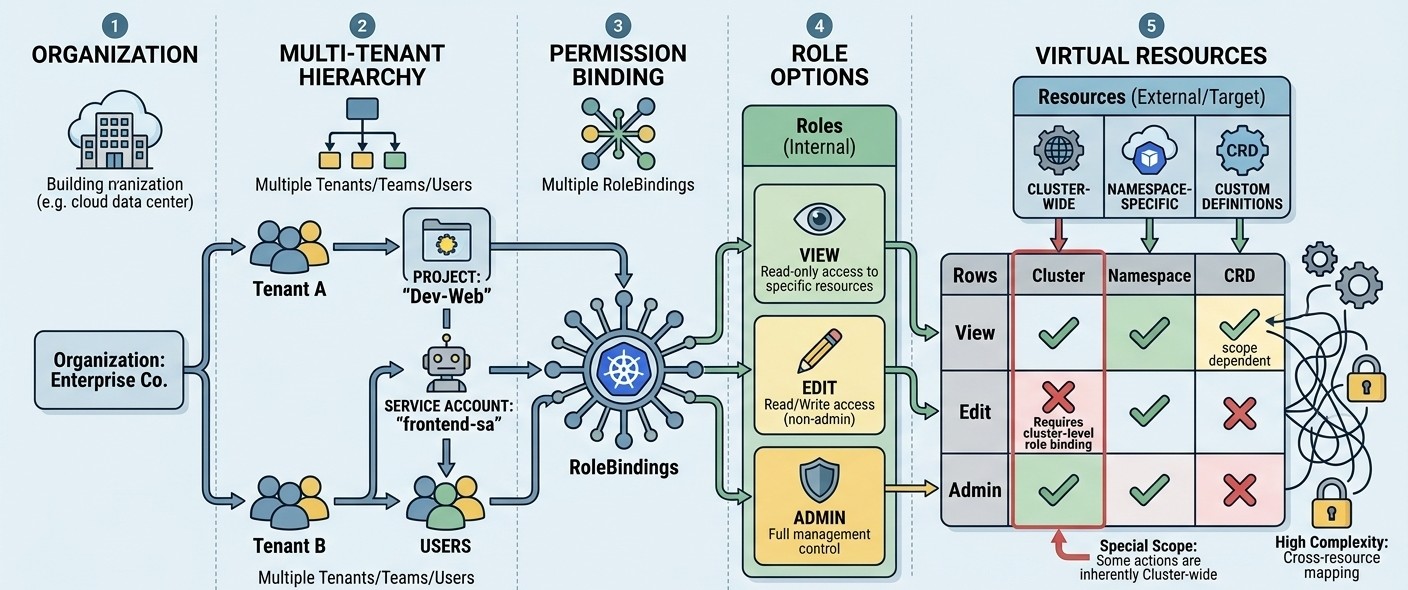
This blog explores and compare those paths, to provide a hints of reasonable Multi-tenant solutions for Kubernetes infrastructures
RBAC Taxonomy: Built-in and Custom Role Implementations
Kubernetes roles operate across two distinct boundaries: cluster-wide (`ClusterRole`) and namespace-wide (`Role`), following the exact specifications detailed in the Kubernetes Native User-Facing Roles Reference. When designing a multi-tenant platform, the first rule of thumb is to look toward native, built-in system configurations. Writing entirely custom roles from scratch can become too verbose to manage effectively, causing severe administrative drag that almost always devolves into an audit nightmare.
By standardizing your user blueprints around Kubernetes’ mature, native user-facing roles, you ensure predictable behavior across updates and third-party tooling integration.
| Built-in Role | Binding Scope | Best Use Case & Boundary Isolation Implementation |
|---|---|---|
| view | Cluster-wide | Serves as an optimized global read-only audit layer across all tenants. Implemented for cross-functional dashboard users, platform monitors, and security compliance auditors who need absolute visibility without mutation risk. |
| Namespace-wide | Assigned directly to localized application engineers, read-only testing teams, or namespace-scoped dashboards to inspect local workloads, pods, and services without exposing cross-tenant data. | |
| edit | Cluster-wide | Explicitly implemented for global automation engines, cross-tenant operators, shared logging collection managers, or global controllers that require absolute workload modification rights across all namespace pools. |
| Namespace-wide | The standard blueprint for application developers. Permits full CRUD control over workloads (Deployments, PVCs, Services) to build out features independently while locking them securely inside their slice. | |
| admin | Namespace-wide | Reserved for "Tenant Owners." Grants complete internal control over a specific namespace slice, enabling self-service team onboarding via local RoleBindings and localized NetworkPolicies configuration. |
| cluster-admin | Cluster-wide | Restricted strictly to the platform core infrastructure engineering team. Grants absolute supremacy over nodes, global CRDs, admission controllers, storage layers, and multi-tenant quota boundaries. |
Scrutiny: Where Tenancy Implementaion Is Placed?
Where the Tenancy Mapping is implemented is critical for the result of agility, usability scalability and complexity
Upstream Kubernetes provides foundational access control primitives, including Roles, RoleBindings, and ServiceAccounts. But it has no Tenancy Implementation.
Beyond upstream of CNCF, this non-standard implementation choice led to different implementations we can see at market. Choice of where the tenancy implementation is implemented is critical factors for the agility, usability scalability and complexity of eventual solutions.
Let's look at the two possible paths of implementation below:
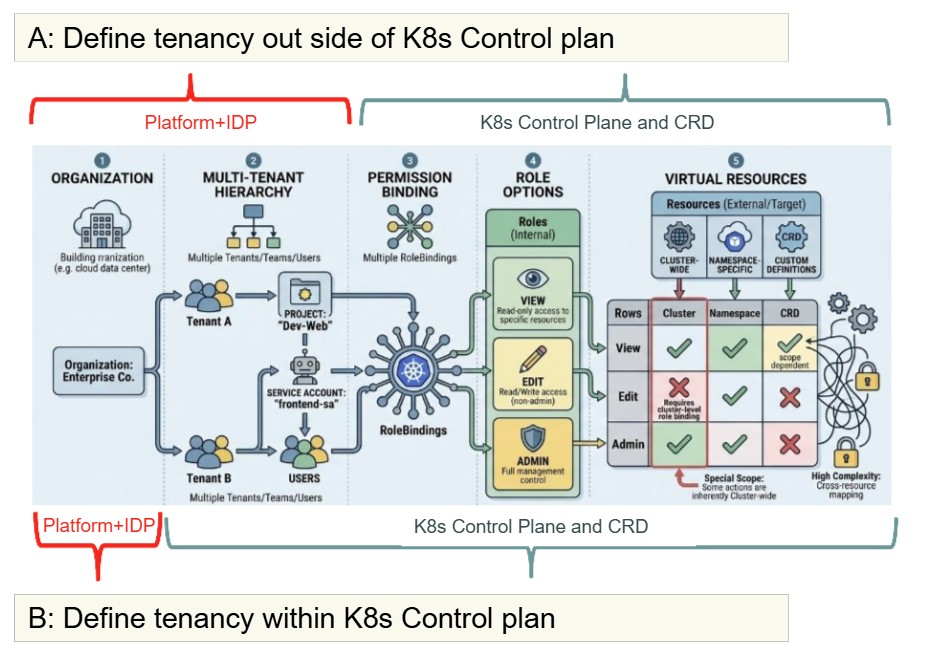
Option A leverages platform, such as Uniview, external hub platform to achieve tenancy mapping, meaning it requires no custom CRDs or binary installations within the Kubernetes Control Plane. Option B builds mapping mechanisms directly inside the Kubernetes control plane to handle relations between tenants, service accounts, and tokens. While both work, they lead to completely different architectural outcomes for different use cases.
| Dimension | Option A: External Platform Model | Option B: In-Cluster Controller Model |
|---|---|---|
| Architecture | K8s control plane handles Roles, Service Accounts, and Namespaces; the external platform implements Tenant and Group Binding. | K8s control plane handles Roles, Service Accounts, Namespaces, Tenant groups, and bindings all internally. |
| Agility | 🟢 Excellent – Changes happen cleanly outside of the cluster control plane. | 🔴 Poor – Configuration alterations occur deep inside the cluster control plane. |
| Scalability | 🟢 Excellent – Tenancy mappings can seamlessly stretch across multiple clusters. | 🔴 Poor – Every single cluster requires CRDs and binary installations. |
| Integration Effort | 🟢 Zero Impact – No requirements on the cluster; utilizes only standard, generic multi-tenancy primitives. | ⚠️ High Complexity – Requires difficult installation and maintenance of cluster binaries and CRDs. |
| State Drift | Potential risk of minor state drift over time between the platform and cluster. | 🟢 Excellent – Keeps tight, reliable direct state synchronization inside the cluster. |
| Vendor Lock-in | 🟢 None – Completely decoupled from the underlying cluster infrastructure. | 🔴 High Lock-in – Deeply coupled with the specific controller implementation. |
| Sustainability | 🟢 High – Clean, maintainable, concise, and highly scalable for long-term production operations. | 🔴 Low – Overkill for long-term management; lacks scaling efficiency. |
| Examples | Uniview Kube Hub, Rancher, Spectro | Capsule, Stakater, OpenShift, Loft Labs |
Implementing a multi-tenant platform can be a decoupled, secure user management plane to handle tenant identity and authentication. Or patching the core to simulate the need of multi-tenancy, when Kubernestes original was not designed for Multi-Tenancy. At industry solutions, Capsule, Stakater are typical patching path on the control plane. vCluster is a bit different, but it is generally part of option B. First of all it implements Tenant concept by a new standalone control plane embedded in the hosting control plane, but there is more issues in state sync and resource allocation controlling by itself.
Multi-Tenant Console Considerations
When building management interfaces or administrative views for multi-tenant users, the guiding design star must be the Principle of Least Privilege. A strong console layer ensures that developers get exactly the level of access they need to move fast, without leaving behind open doors that risk cluster stability.
- Discovery with Minimal Harm: Design dashboards to let users safely discover allowed endpoints, dependency state mappings, and shared resources through global visibility parameters, while strictly enforcing scoped proxy checks behind any action button.
- The Dual-Track Sync: Console modifications must gracefully coexist alongside automation platforms like ArgoCD. If user-facing actions in the UI conflict with GitOps source-of-truth repo access levels, continuous reconciliation processes will immediately overwrite user changes, fracturing the developer experience.
- Cluster Read vs. Namespace Write: A highly effective tenant pattern involves giving users cluster-wide read configurations to cross-reference infrastructure architectures, paired with strict write operations constrained cleanly inside their specific namespace walls.
Token Considerations and Guardrails
Authentication protocols define the integrity of your multi-tenant boundary. If access tokens are managed lazily, your isolation architecture fails automatically, regardless of how secure your underlying RBAC rules are. But token design is also critical for dail services. A few principles: if not needed, expose IDP token, instead of K8s token, UI and dashboard token vs token used in automation, Token obtaining must be a well vetted process,
- Short-Lived Sessions by Default: Standard interactive developer access must prioritize ephemeral, short-lived tokens generated via secure OIDC providers or temporary Kubeconfig credentials. Forcing automatic expiration windows prevents leakage vectors if developer laptops or credentials are ever compromised.
- Long-Lived Tokens as the Monitored Exception: Long-lived service account tokens must be treated as exceptional edge cases. Reserve them exclusively for headless automation engines, machine-to-machine integrations, or webhook services, and protect them behind aggressive auditing and alerting loops.
Token Governance Lifecycle: Visibility and Acquisition Frameworks
The integrity of a multi-tenant boundary depends entirely on token exposure and retrieval design. To maintain an agile platform, token accessibility must be carefully mapped to the user's immediate environment. A secure multi-tenant platform must differentiate between exposed tokens used for high-frequency interactive interfaces and hidden tokens used by background service workloads.
Operational Principles of Token Visibility
- Direct Accessibility for High-Frequency Interfaces: For interactive developer access, web UIs, and administrative dashboards that demand heavy HTTP request volumes, short-lived tokens must be directly accessible to the user or browser client. This allows the client side to securely authenticate and statefully manage massive, direct API interactions without routing every request through a bottleneck proxy.
- Abstracted Visibility for Managed Service Pods: When tenants consume infrastructure purely "as a service"—where the underlying application or pod acts as a managed engine—the user does not need direct Kubernetes API access. In these scenarios, the underlying workload tokens must be hidden and completely inaccessible to the end user, preventing accidental privilege escalation or structural leakage.
- Self-Service Token Acquisition Workflows: Rather than forcing users through rigid, manual pipelines, a mature multi-tenant platform must natively facilitate token discovery. It should provide user-facing interfaces or CLI mechanisms that allow teams to seamlessly obtain the exact type of token they require for their immediate task (e.g., UI tokens vs. automation tokens), backed by the appropriate validation process for that specific scope.
Tactical Guardrails: Token Classification Matrix
To implement these guidelines consistently, multi-tenant operators categorize tokens into two clearly separated operational boundaries:
| Token Scope | Lifespan Category | User Accessibility & Acquisition Pattern | Target Use Case & Verification Patterns |
|---|---|---|---|
| Interactive Client Tokens | Short-Lived (Ephemeral Session) |
Fully Accessible | High-Frequency UI & CLI Interaction: Exposed directly to the client browser or local CLI environment. Used for web-based developer portals, rich dashboards, and rapid HTTP-based querying where the client layer must send direct authenticated requests. These are bound strictly to Identity Provider (IdP) session timeouts (e.g., 1–8 hours) and require automated refresh flows. |
| Long-Lived (Unsupported Profile) |
Strictly Not Allowed | Prohibited Access Vector: Generating static, long-lived credentials for human or interactive developer sessions violates core multi-tenant security architecture rules. Platform controls explicitly block this setup to prevent unmitigated credential leakage and persistent cluster access risk. | |
| Workload Service Tokens | Long-Lived (Machine-to-Machine) |
Extra Vetted Process (Facilitated by Uniview) |
Headless Core Automation & Abstracted Platform Services: Reserved for background cluster services, GitOps controllers (e.g., ArgoCD/Flux), machine-to-machine integrations, or embedded components where the user interacts with a top-level application service rather than raw Kubernetes APIs. Rather than being unmanaged or blindly hidden, acquisition is handled via an extra vetted setup facilitated natively by platforms like Uniview to govern issuance, enforce explicit audience (aud) boundaries, and tie consumption to strict auditing loops.
|
Conclusion: Scalable Access Governance
As the operational overhead of cloud infrastructure scales, multi-tenancy transitions from a theoretical design pattern into a foundational technical requirement. Managing a highly optimized, shared Kubernetes landscape requires moving past cluster-sprawl models and implementing structured, fine-grained access control layers.
As a practical application of these principles, Uniview Kube Hub serves as a production-proven example of this architecture in action. By standardizing user blueprints around native, predictable built-in roles, aligning dashboard interfaces with need of declarative GitOps tools, and enforcing deterministic token management guardrails, platform engineering teams can achieve multi-tenant isolation at scale. Implementing these core access patterns ensures that hundreds of distinct workloads can securely inhabit shared compute resources—maximizing hardware efficiency, driving down operational costs, and maintaining architectural performance boundaries.
For more details on how to implement these multi-tenancy frameworks within your own infrastructure, contact us today!